RESTORATION
of AC's post-war 2 Litre SaloonPage 4
Plywood Sections

Bulkhead.
For the plywood bulkhead, there are several small ribs that fix to its edge. The top corners of the plywood hook over 2 of these ribs, making it impossible to install (with bodyshell in place) unless you miss out a bit of panel and add packing pieces afterwards. One rib on each side of the scuttle area, fits just under the bodyshell, which is awkward, but you can just get these in after installing the plywood. It is easier of you have a car with scuttle ventilators (late 1950 onwards), as these reveal a bit more of the scuttle side region.
There are also some plywood distance pieces fitted to the front face of the bulkhead. The rubber bonnet seal normally rests upon these, and the alloy part of the bulkhead screws to these distance pieces and they need to be aligned with the top edge of the alloy.

A new bulkhead, but re-using the hardwood strip salvaged from the original.

The top left-hand corner of the new bulkhead with holes for wiring and wiper-rack to pass through.

The new bulkhead screwed and glued onto the frame. The ribs down each side are not yet installed.

Test fitting the aluminium part of the bulkhead, to get perfect alignment of the top edge.
Boot side panels.
The plywood boot side panels are very awkward to install with the alloy panelling in place. Each one has 3 ribs fixed to its edge, with screws driven into the edge of the plywood, and these have to be dug out. Two more screws go through the rear shelf into the plywood edge. Another screw goes at an angle through the rear end of the plywood into the rear cross-member. The chances are that the boot side panel has rotted enough to make removal easy. Fitting a complete new panel, under the bodyshell, is impossible without making modifications. Patching up the old one would facilitate easy installation. The problem is that the bodyshell, and those 3 ribs, prevent you from manoeuvring the plywood back far enough, to get it in passed the rear shelf assembly.
A repaired plywood panel made from 2 or 3 sections, would overcome this, but I do not recommend trying to patch up plywood. A repair is unlikely to be strong enough unless you can heavily reinforce it. These panels help to support the rear structure of the body and bolt to the chassis, and so take some loading especially when the car twists. Also, repairs might be visible, and unsightly, within the boot, unless you install trim that will hide it. An alternative approach (which I've not tried myself), would be to make a complete new boot side panel, but with a small section removed from the top where it fits behind the rear shelf when installed. A separate detachable section could then fill this gap, and a join in this area will not affect the main load paths between the bodywork and the chassis. It's an idea! It should also make later removal less difficult, especially if there is ever crash damage to repair (heaven forbid!).
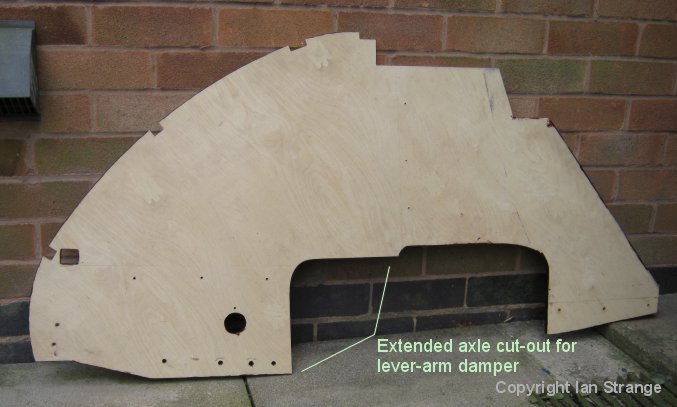
There were at least 2 versions of the boot side panel. The earlier version has the axle cut-out extended a long way back to clear the lever-arm damper. Many of these earlier ACs (up to early 1950) subsequently had the lever arm dampers removed. The large gap left can let in dirt and spray, but is also handy to help when working on this region, where there is limited access at the best of times. The later version of the boot side panel, has a sloping rear edge to the axle cut-out that lines up with the damper sub-frame. The photos below show both versions. When doing the axle cut-out, be careful that it does not overlap the boot area, leaving a gap visible from inside the boot.
It is worth taking time for a perfect fit of this component. Also, I drilled the bolt holes undersize and then filed them out to align perfectly with the holes in the chassis.
The right-hand panel has a recess to clear the petrol filler pipe. Clearance may be very tight, and my original panel was damaged by the pipe. For my new panel, I removed more material for greater clearance, and then glued a reinforcement piece of wood to the outer side of the panel.
Where the boot side panels fit into a slot on the rear cross-member, there is a no.8 woodscrew that passes through at a 45 degree angle to fasten the panel down securely. This was fitted from the outer side, which is hard to get in or out without dismantling the entire back end, even with body-shell removed! So, I've inserted mine from the inside, still at 45 degrees. A pair of no.10 screws hold the panel (rear end) to the wheel-arch, separated by a distance block.
If you have removed the bodyshell, then it is quite straight forward to completely renew all the major plywood sections on the AC.



Wing panels.


The little detachable plywood panels that bolt onto these plywood wing panels, are also easy to make, although one has to unfold the alloy panelling to slide the new plywood in. You will need to fit two 1/4" BSW coach-bolts before inserting the plywood into the alloy panel, and wing-nuts hold the finished panels in place.
Unfortunately, these panels are the first wood components to rot away, since they form the rear end of the front wing, with all the mud and spray thrown at them. Apart from protecting them with paint (and water-proof adhesive on the ply edges), it might be best to fit a sheet of rubber over the large access hole (fixed by the same coach-bolts that hold the little detachable panels on). It is important not to let this plywood rot, because it helps to support the doorstep.
Rear shelf panel.
If you thought any of those parts were awkward, then the rear shelf panel is even worse! At each end, there are a pair of screws that pass through the wheel arch, then the panel, and into the shelf assembly. That is, the ends of the plywood are sandwiched between other parts. What is more, there are 2 additional pairs of screws that are hidden above the wheel arch component. Other components are nailed to the rear edge of the shelf panel. The only way to extract this panel is to cut off the ends, remove most of the plywood, and then destroy the ends to expose the screws, which either need cutting, or else have rusted away.


Under window panel.
This is a curved panel just 3mm in thickness, with the outer grain running vertically for easy bending. It is nailed into place, with the nails angled downwards for the bottom row and upwards for the upper row.
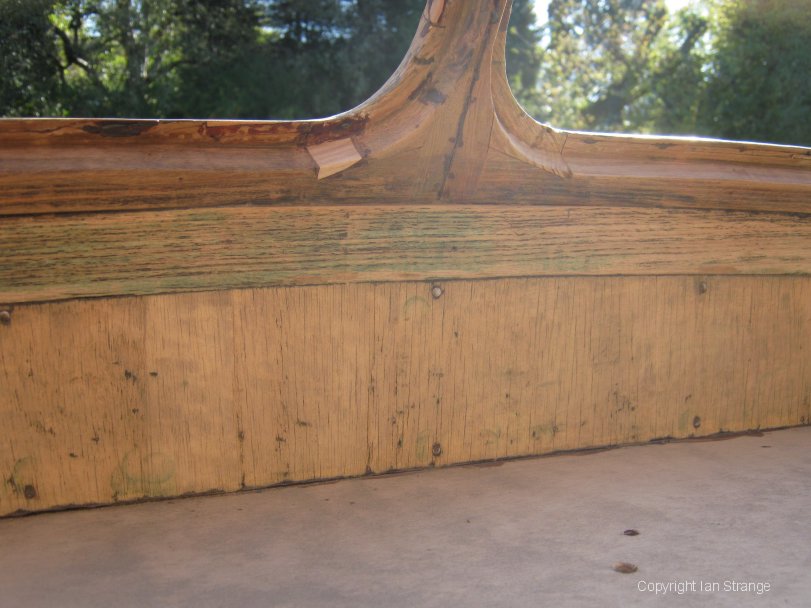
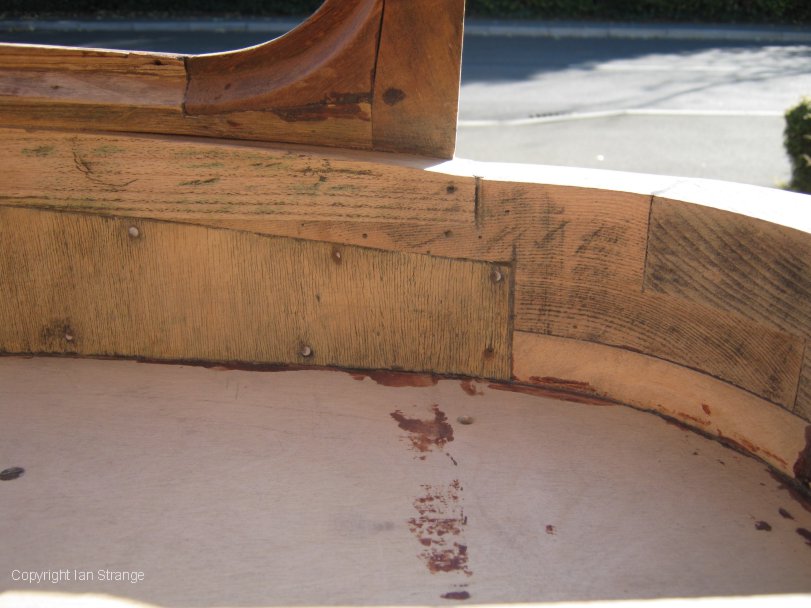
Important note: Make sure that the chassis is not twisted when taking measurements, doing trial fits, or aligning screw and bolt holes (and when finally gluing the panel into place). Have the car resting on its wheels, on flat ground, or if on stands/blocks, make sure it is supported close to axle level, and check for chassis twist.
Boot floor
The original boot floor was made from relatively cheap 5-ply wood panelling, 3/8" (9.5mm) thick. I renewed mine with stronger 7-ply material, and as with all my other new plywood, this is exterior quality.
This floor has two slots cut out for the boot-lid stays to pass through when you close the boot-lid. There are also two access holes for the rear spring bolts. These are covered by aluminium plates that are each secured with a pair of round-head woodscrews - with keyhole shaped holes for the screws in the plates, so that you don't need to remove the screws to gain access.
Earlier cars fitted with (or originally fitted with) lever-arm dampers, also have access holes cut out of the leading corners of the boot floor, as seen in the photos here.
The floor is secured by three no.8 x 1" woodscrews along each of the two sides, to support battens. And is also bolted to a steel bracket below the boot-lid hinges. The floor rests upon the spare wheel compartment panelling, but cushioned by a thick strip of hessian cloth.

The original boot floor being used as a pattern
to mark out a new one.

Top view of new boot floor complete with fittings: 2 alloy plates, 2 wooden battens and a steel angle bracket.

Underside view of new boot floor with fittings, including small wooden block.

Steel angle bracket, which bolts to the leading edge
of the floor. And one of the aluminium plates that
covers an access hole in the floor.

Hessian padding that is used between the spare wheel compartment panelling and the underside of the boot floor.

This small wooden block is screwed to the underside
of the boot floor. It holds down the spare wheel.
This one relates to the thinner 5.50" section tyres,
and so a thinner block (or none at all?) may be required
for wider tyres. The block's rear edge was painted bodywork colour.
The rest, like the boot floor itself, was painted black with bitumen.

Test fitting of new boot floor.

Checking that the boot-lid stay passes through the slot in the new floor.
After making the components, the exposed edges should be sealed to keep out water and also to bind the edges to prevent damage/splintering. I think this is best done by using a fully waterproof adhesive such as "Aerodux" or equivalent.
The 3 photos below show a new shelf panel being test fitted.

